ALASKA LICENSING GUIDE

How to become a pharmacy technician in Alaska

Begin your pharmacy technician career in Alaska. Learn how to register with the state and the benefits of becoming a Certified Pharmacy Technician (CPhT).

A technician working in a pharmacy in AlaskaAlaska flag
Alaska does something most states don't. Instead of a single pharmacy technician license, the Alaska Board of Pharmacy issues two separate licenses: a basic Pharmacy Technician license and a higher-tier Pharmacy Technician with National Certification license. The two roles look almost identical on paper but legally, they are very different jobs.

The basic-tier license lets you work as a pharmacy technician under the supervision of a pharmacist, performing the duties your pharmacist-in-charge has trained you to do. The upper-tier license, available only to technicians who hold a national certification (like the PTCB's CPhT credential), unlocks a meaningfully larger scope of practice. Certified technicians in Alaska can perform the final check on non-controlled prescriptions, transfer prescriptions, clarify prescriber information, and administer vaccines, all of which basic-tier technicians are legally barred from doing.

This guide covers both paths. You'll find a side-by-side breakdown of the two tiers, the exact steps and fees to get licensed, what the PTCB exam looks like, salary data for pharmacy technicians across Alaska, and a step-by-step roadmap that takes you from no experience to fully licensed and certified.

Alaska Board of Pharmacy 

Alaska pharmacy technician licensing requirements

To work as a pharmacy technician in Alaska, you must hold a current pharmacy technician license issued by the Alaska Board of Pharmacy. The application is the same regardless of whether you are pursuing the basic-tier license or the upper-tier Pharmacy Technician with National Certification license. The difference comes down to whether you can document a national certification on the form.
  • Age: You must be at least 18 years old. Applicants who are at least 16 may apply if they are enrolled in a documented apprenticeship program.
  • English fluency: You must be able to read, write, and speak English fluently.
  • Education: You must hold a high school diploma, an equivalency diploma (GED), or be enrolled in an apprenticeship program with documentation attached.
  • Social Security Number: A Social Security Number is required by Alaska Statute 08.01.060. However, if you do not have one, an SSN exemption form is available.
  • Background history disclosure: The application asks about prior license actions, criminal history, and any condition that could affect your ability to practice safely. A "yes" answer does not automatically disqualify you, but each one must be explained in writing with supporting documentation.

Alaska does not require you to complete a formal pharmacy technician school before applying. The pre-license training is delivered by the pharmacist-in-charge at the pharmacy that hires you. That said, completing a structured training program before you apply makes you significantly more competitive and will qualify for the upper-tier license right away.

References:

Alaska pharmacy technician licensing requirements are established under 12 AAC 52.230 and AS 08.80

The two tiers of Alaska pharmacy technicians

Alaska's two-tier system is the single most important thing to understand if you are planning your career here. Both tiers require the same $25 license, but the upper tier, Pharmacy Technician with National Certification, is governed by a separate regulation (12 AAC 52.235) that significantly expands what you are legally allowed to do.

Here's a side-by-side look at how the two roles compare.

Pharmacy Technician

  • Enter prescription data into the pharmacy system
  • Count, measure, and label medications
  • Package prescriptions for dispensing
  • Assist with inventory and stocking
  • Reconstitute oral suspensions
  • Assist with compounding tasks
  • Perform the final check of a non-controlled prescription
  • Transfer non-controlled prescription drug orders
  • Clarify or obtain missing information from prescribers
  • Administer vaccines or emergency medications

Certified Pharmacy Technician

  • Enter prescription data into the pharmacy system
  • Count, measure, and label medications
  • Package prescriptions for dispensing
  • Assist with inventory and stocking
  • Reconstitute oral suspensions
  • Assist with compounding tasks
  • Perform the final check of a non-controlled prescription*
  • Transfer non-controlled prescription drug orders
  • Clarify or obtain missing information from prescribers
  • Administer vaccines or emergency medications**
* Final verification requires a prior pharmacist drug-regimen review, a pharmacy bar-code scanning & verification system, software that displays the correct drug image, and electronic documentation of every prescription distributed.
** Vaccine administration requires an active national certification, completion of an ACPE-accredited immunization course, and current CPR/AED training.

Why the certification matters

It is worth being concrete about what the upper tier unlocks. Under 12 AAC 52.235, a nationally certified pharmacy technician working under direct pharmacist supervision can:
  • Perform the final check on non-controlled prescriptions. This is the kind of "tech-check-tech" workflow that hospitals and high-volume retail pharmacies rely on, and it is unavailable to basic-tier technicians anywhere in the state.
  • Transfer non-controlled prescription drug orders. When a patient calls to move a prescription from one pharmacy to another, only certified technicians can handle that transfer.
  • Clarify or obtain missing information from prescribers. Calling a doctor's office about a non-controlled prescription is a routine part of pharmacy work, and Alaska reserves it for the upper tier — with documentation requirements that include the result of the call, the technician's initials, who was spoken to, and the date.
  • Administer vaccines and related emergency medications. Under 12 AAC 52.992, certified technicians who complete the required immunization training can give FDA-authorized vaccines, which has become one of the most valuable skills a pharmacy technician can hold.
Practically speaking, the upper tier is what most Alaska employers want — especially hospitals, health-system pharmacies, and anywhere immunization services are offered. If you are starting from scratch, the most efficient path is to earn your national certification first and apply for the upper-tier license from day one.

References:

Scope of practice for Alaska pharmacy technicians is set out in 12 AAC 52.230 (basic license) and 12 AAC 52.235 (national certification license).
Vaccine administration requirements are governed by 12 AAC 52.992.
CAREER ADVANTAGES OF CERTIFICATION

Why become a Certified Pharmacy Technician (CPhT) in Alaska

In states where pharmacy technicians have a single license tier, certification is mostly a credential that helps you stand out. In Alaska it is something more concrete: it is the legal gatekeeper between two different jobs. Earning your CPhT through the Pharmacy Technician Certification Board (PTCB) is what qualifies you for the upper-tier license which lets you do the more clinical and better-paid work in the field.

The Alaska Board of Pharmacy also accepts certifications issued by the National Healthcareer Association (NHA), but the CPhT from PTCB is by far the most widely recognized credential in the U.S. and is the one most employers will look for on a resume.

Administer vaccines

The upper-tier license is the only path to vaccine authorization in Alaska. Certified techs who complete an ACPE immunization course and CPR/AED training can give FDA-authorized vaccinations.

Earn higher pay 

Alaska is consistently a top-five-paying state for pharmacy technicians. Certified techs qualify for hospital, specialty, and lead-tech roles that sit at the high end of the wage scale.

Access more opportunities

Hospitals, health systems, and specialty pharmacies in Anchorage, Fairbanks, and Juneau prefer or require certified candidates. And those settings typically offer the strongest career growth.

Take on real responsibilities

Final prescription checks, transfers, and prescriber clarifications are reserved by Alaska law for certified technicians. These are the tasks that move you from data entry to professional contribution.

Hit the ground running

Arriving certified means less onboarding. You already know drug classifications, pharmacy law, and workflow, which makes you productive on day one and easier to schedule across shifts.

Build a long-term career

Many CPhTs advance into lead technician, specialty, compounding, or pharmacy operations roles over time. Certification is the foundation for a meaningful, growing healthcare career.

Pharmacy technician salary in Alaska

Alaska is one of the highest-paying states in the country for pharmacy technicians. According to the U.S. Bureau of Labor Statistics, Alaska ranks consistently in the top five states for the role, alongside California, Washington, Oregon, and the District of Columbia. 

Average annual wage

$52,040

Per year in Alaska

Mean hourly wage

$25+ per hour

Statewide average

Top earners

$64,600+ /yr

With certification

How Alaska compares nationally

Alaska's median pharmacy technician wage of $52,040 is roughly $9,000 higher than the national median of $43,460. Entry-level pay in Alaska (10th percentile) starts at about $38,650, which is itself above the national entry-level rate. Cost of living is part of the story since Alaska's living expenses run higher than most of the Lower 48. But even after that adjustment, the take-home math tends to favor pharmacy technicians who work here over technicians in most other states.

In Alaska, the higher-paying roles are the ones that require or strongly prefer certification. If you are starting from scratch, completing a training program and earning your CPhT before you apply lets you enter the workforce already qualified for those roles, rather than having to climb out of an entry-level position.

Where the jobs are

The Anchorage Metropolitan Statistical Area, which includes Anchorage Municipality and the Matanuska-Susitna Borough, is by far the largest employer of pharmacy technicians in Alaska. Fairbanks, Juneau, and the Kenai Peninsula round out the major job centers. In rural and frontier communities, pharmacy technician roles are often part of broader healthcare-team positions in tribal health corporations, regional hospitals, and Indian Health Service facilities. These settings frequently prefer certified candidates and offer competitive benefits.

Sources:

Wage data from the U.S. Bureau of Labor Statistics, Occupational Employment and Wage Statistics, (SOC 29-2052) and the BLS Anchorage Metropolitan Area news release. Supplementary metro-level data from Salary.com.
Figures are estimates and may vary by employer, experience, certification status, and exact location.

PTCB certification: Exam overview and eligibility

In some states pharmacy technician certification is an optional nice-to-have that helps with hiring. However, in Alaska, the two-tier structure makes it functionally a different license. If you want to do the work that defines a modern pharmacy technician you need a national certification, and you need to apply for the upper-tier license under 12 AAC 52.235.

The most widely recognized national certification is the Certified Pharmacy Technician (CPhT) credential, awarded by the Pharmacy Technician Certification Board (PTCB) after passing the Pharmacy Technician Certification Exam (PTCE). Alaska also accepts NHA certifications for the upper tier, but PTCB's CPhT is the one most employers list in job postings and the one that travels best if you ever practice outside Alaska.

What is the PTCE?

The Pharmacy Technician Certification Exam is a computer-based test administered at Pearson VUE testing centers, including locations in Anchorage and Fairbanks. As of December 2025, online proctored testing has been permanently discontinued, so the exam is in-person only.
  • 90 multiple-choice questions (80 scored, 10 unscored pilot questions)
  • 2-hour time limit
  • Scored on a 1000–1600 scale; passing score is 1400

The exam is designed to reflect real-world pharmacy tasks. With the right preparation, most students find it very manageable.

What is on the exam?

The PTCE outline was updated effective January 6, 2026. The exam covers four main knowledge domains:
  • Medications (35%)
    Brand and generic names, drug classifications, indications, dosing, side effects, interactions, and proper storage
  • Pharmacy laws and regulations (18.75%)
    DEA controlled substance schedules, recordkeeping, FDA recalls, restricted drug programs, and federal pharmacy law
  • Patient safety and quality assurance (23.75%)
    Preventing medication errors, hygiene, hazardous-drug handling, and quality-improvement processes
  • Order entry and processing (22.5%)
    Reading prescriptions, performing pharmacy calculations, NDC numbers, lot numbers, expiration dates, and workflow

Eligibility requirements

To sit for the PTCE, you must meet one of the following:
  • Complete a PTCB-recognized education or training program, OR
  • Accumulate at least 500 hours of verifiable pharmacy technician work experience
Most students are able to prepare for and pass the PTCE within a few months using a structured study plan.

Why most students choose a training program

While it is possible to qualify through work experience, most students choose to complete a PTCB-recognized training program. Here is why that approach makes sense:
  • A training program makes you eligible for the PTCE the moment you finish, with no waiting period to accumulate hours.
  • The PTCE covers both retail and hospital pharmacy content. Working in just one setting can leave gaps in the material you'll see on exam day.
  • In Alaska, that means qualifying for the upper-tier license from day one, rather than working at the basic tier while you accumulate hours and study on the side.
  • Federal requirements are now the second-largest section of the PTCE. Most on-the-job training won't expose you to the full breadth of DEA recordkeeping rules, controlled substance ordering, or FDA programs in any structured way.
Not every pharmacy technician program qualifies you for the PTCE without prior work experience. Before enrolling, look for the official PTCB-Recognized Education/Training Program seal. It confirms the curriculum meets PTCB standards. 
Programs like the 1st Pass CPhT Course by Pharmacy Technician Academy are designed to take you from no experience to exam-ready in about 2–3 months. The course is fully online and self-paced, which works well for Alaska students whose access to in-person training programs varies sharply by region.

Step-by-step guide to becoming a pharmacy technician in Alaska

Here is the most efficient path from no experience to fully licensed and certified at Alaska's upper tier. The order matters since earning your national certification before you apply is what qualifies you for the upper-tier license under 12 AAC 52.235.

Step 1: Complete a PTCB-recognized pharmacy technician training program
Start with a structured, PTCB-recognized pharmacy technician training program. This is what qualifies you to sit for the PTCE without waiting to accumulate work hours, and it is the single most important investment you can make in your career as an Alaska pharmacy technician.

The 1st Pass CPhT Course by Pharmacy Technician Academy is fully online, self-paced, and PTCB-recognized. It qualifies you to sit for the PTCE exam without needing prior work experience.

Step 2: Pass the PTCE and earn your CPhT

Schedule your PTCE through PTCB at ptcb.org and take the exam at a Pearson VUE testing center. The exam is now offered in person only but Anchorage and Fairbanks both have testing locations.

When you pass (the cutoff is 1400 on the 1000–1600 scale), you earn the Certified Pharmacy Technician (CPhT) credential. This is what qualifies you for Alaska's upper-tier license.

Step 3: Apply for your Alaska pharmacy technician registration
With your CPhT in hand, file your Alaska license application. The fastest path is to file electronically through your MyAlaska account, which gives you email notifications about your application status. You can also download Form 08-4353, have it notarized, and mail it with a $25 check (payable to "State of Alaska") to the Board of Pharmacy at PO Box 110806, Juneau, AK 99811.

On the application, complete Part V to indicate that you hold a national certification. That's what triggers licensure under 12 AAC 52.235 rather than the basic tier. If you also plan to administer vaccines, indicate that you have completed an ACPE-accredited immunization course and current CPR/AED training.

Step 4: Start your career fully licensed and certified

Once your license is approved, you are ready to work as a Pharmacy Technician with National Certification in Alaska. This means you'll be fully credentialed at the higher tier from your very first day on the job.

You'll qualify for hospital, specialty, and immunization-authorized roles that basic-tier technicians cannot do. You'll have stronger negotiating power on starting pay. And in a state where the certified workforce is small relative to demand, that combination tends to translate quickly into higher paying job offers.

Frequently asked questions about Alaska pharmacy technician licensing

Do I need a license to work as a pharmacy technician in Alaska?

Yes. Alaska requires anyone who assists in the practice of pharmacy to hold a pharmacy technician license issued by the Alaska Board of Pharmacy. The state recognizes two tiers: a basic Pharmacy Technician license and a Pharmacy Technician with National Certification license, which carries expanded duties. People whose responsibilities are purely administrative, such as bookkeepers, accountants, delivery drivers, do not need a pharmacy technician license.

How do I get a pharmacy technician license in Alaska?

You must be at least 18 years old (or 16 and enrolled in a documented apprenticeship program), fluent in English, and hold a high school diploma or GED. You'll then complete the Alaska Pharmacy Technician License Application (Form 08-4353), have it notarized, and submit it with the $25 fee to the Board of Pharmacy. You can file electronically through MyAlaska or by mail to the Board's Juneau P.O. Box. Pre-license training is delivered by the pharmacist-in-charge at your employing pharmacy.

How much does a pharmacy technician license cost in Alaska?

The total cost is $25, payable to the State of Alaska. Licenses are issued for a two-year period and expire on June 30 of even-numbered years, regardless of when the license was originally issued. Licenses issued within 90 days of an expiration date are automatically extended to the next biennial expiration.

What is the difference between an Alaska pharmacy technician license and a CPhT certification?

Your Alaska pharmacy technician license is issued by the Alaska Board of Pharmacy and is what allows you to legally work in the state. Your CPhT is a separate national credential issued by the Pharmacy Technician Certification Board (PTCB) and earned by passing the PTCE.

In Alaska, holding a national certification is what qualifies you for the upper-tier license under 12 AAC 52.235, which permits final verification of non-controlled prescriptions, prescription transfers, prescriber clarifications, and vaccine administration.

Is PTCB certification required to work as a pharmacy technician in Alaska?

No, PTCB certification is not required to obtain a basic pharmacy technician license. However, it is required if you want to be licensed as a Pharmacy Technician with National Certification, which is the only tier permitted to perform final prescription verification, prescription transfers, prescriber clarifications, or vaccine administration.

Is it worth getting CPhT certified in Alaska?

Yes, arguably more so than in most states. Because Alaska's two-tier system reserves several core pharmacy duties for certified technicians, your certification is essentially what determines what kind of pharmacy technician work you are allowed to do. Beyond the legal scope-of-practice difference, certified techs in Alaska earn more on average, qualify for hospital and immunization roles, and have stronger leverage with employers in a small state where the certified workforce is in real demand.

How long does it take to become a pharmacy technician in Alaska?

Most students complete the entire process in about 3–4 months following the most efficient path outlined above. The training program itself takes 2–3 months at a typical pace, with additional time for scheduling the PTCE and processing your Alaska application.

Do I need a high school diploma or college degree to become a pharmacy technician in Alaska?

You need a high school diploma or equivalency diploma (GED). Alaska does not require a college degree, and there is no requirement to attend a formal pharmacy technician school before applying. The pre-license training is delivered by the pharmacist-in-charge at your employing pharmacy. Applicants who are at least 16 may apply if they are enrolled in a documented apprenticeship program.
Begin YOUR PHARMACY TECHNICIAN CAREER

Ready to get started?
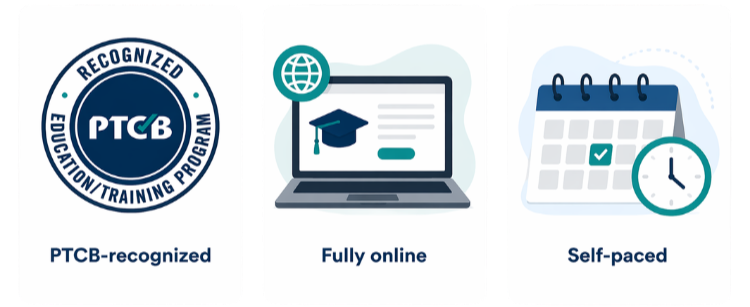
Alaska's two-tier license is one of the strongest reasons to certify before you apply. Earning your CPhT first means you enter the workforce already qualified for the upper-tier license with access to vaccine administration, prescription transfers, final verification, and the higher-paying hospital and specialty roles that come with them.

The 1st Pass CPhT Course is a fully online, PTCB-recognized training program built around the updated PTCE content outline. It's designed to get you exam-ready in 2–3 months so you can start your Alaska career as quickly as possible.

What’s included:

  • 6 months of course access
  • Step-by-step guidance through the certification process
  • Practice exams and interactive learning tools
  • Coverage of all PTCE exam topics
  • Instruction designed to help you pass on your first attempt

Take the next step

If you are ready to start your pharmacy technician career in Alaska, completing a PTCB-recognized training program is the fastest and most effective path to getting there.

Start immediately after enrollment
No prior experience required