
Utah Pharmacy Technician LICENSING GUIDE
How to Become a Pharmacy Technician in Utah
Becoming a pharmacy technician in Utah takes a few more steps than in most states, but it doesn't require a college degree or years of school. This guide covers Utah's licensing requirements and the fastest, most affordable way to meet them, without paying for a formal training program.

Utah pharmacy technician licensing requirements
References:
How to meet Utah's pharmacy technician training requirement
Weighing the two paths
PTCB certification: Exam overview and eligibility
Exam format and fee
How to get certified without experience
The fastest path to Utah pharmacy technician licensure
Utah's requirements are stricter, and more confusing, than most states. But if you sequence things in the right order, there's a fast, affordable way through them that doesn't involve paying for a formal accredited program.
Here's what that looks like.
Here's what that looks like.
Complete a PTCB-recognized training program
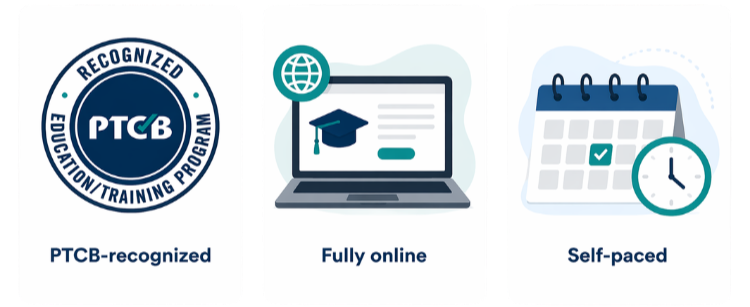
You don't need a Trainee license or any pharmacy experience to start here. PTCB-recognized programs, including the 1st Pass CPhT Course, are built for beginners and can typically be finished online in 2 to 3 months.
Pass the PTCB certification exam
Once you've finished your program, register with PTCB and schedule your exam at a Pearson VUE testing center.
Apply for your Trainee license
With certification already in hand, apply for your Trainee license through DOPL. You'll also need a background check through the Utah BCI and FBI, which requires fingerprinting. Links to both are in the requirements section above.
Apply to Board-approved OTJ training programs, already certified
This is where getting certified first pays off. Employers running Board-approved on-the-job training programs are choosing from a competitive pool of applicants. Walking in with an active CPhT already in hand sets you apart from applicants who are still working toward one.
Complete your 180 hours of hands-on training while employed
Once hired, you'll complete your employer's training program, including the required 180 hours of supervised, hands-on training, while earning a paycheck instead of paying tuition. That single step satisfies both Utah's training and hands-on hours requirements at once.
Apply for your full Pharmacy Technician license
You have two years from your Trainee license date to complete this step. Submit your completed training documentation and certification to DOPL to convert to a full Pharmacy Technician license.
Frequently asked questions about becoming a pharmacy technician in Utah
Do I need a license to work as a pharmacy technician in Utah?
Yes. Utah requires a state license through the Division of Professional Licensing (DOPL) before you can work as a pharmacy technician. This happens in two stages: a Pharmacy Technician Trainee license first, then a full Pharmacy Technician license once you've completed training and certification.
Is national certification required to become a pharmacy technician in Utah?
Yes. Unlike some states where certification is optional, Utah requires it. You must hold a current PTCB (CPhT) or NHA ExCPT certification before DOPL will issue your full Pharmacy Technician license.
What is a Pharmacy Technician Trainee license?
It's the license you hold while you're completing your training and hands-on hours. You need it to legally work under supervision at a pharmacy before you qualify for the full Pharmacy Technician license. Trainees have two years from the date they receive this license to finish training and pass certification.
Can I get PTCB certified before I have any pharmacy experience?
Yes. Completing a PTCB-recognized education program, rather than accumulating work experience, qualifies you to sit for the PTCE with no prior pharmacy experience needed. This is what makes it possible to get certified before you've applied to a Trainee license or an OTJ program.
How long does it take to become a licensed pharmacy technician in Utah?
It depends on the path you take. Completing a PTCB-recognized program and certifying first, then applying to an OTJ program, tends to move faster than enrolling in a formal accredited program with a fixed, often multi-month to year-long, term.
Begin YOUR PHARMACY TECHNICIAN CAREER
Ready to get started?

What’s included:
Take the next step
Where to go from here
ABOUT THIS GUIDE

Redefining pharmacy technician education for the modern world.
Copyright © 2026